This isn’t the best time to be writing (need to clean the house, frost cupcakes and prepare for an outdoor playdate in the rain) but this morning’s Twitter exchange was so fascinating I need to get it down.
Hend Amry (among others, but I follow and like her) posted this
https://twitter.com/LibyaLiberty/status/1320275510300008448
with the images of nuns wearing purple and white habits and (God help us) Maga masks at a T___p rally.
It was a retweet from https://twitter.com/HowardMortman/status/1320143598315241473/photo/1
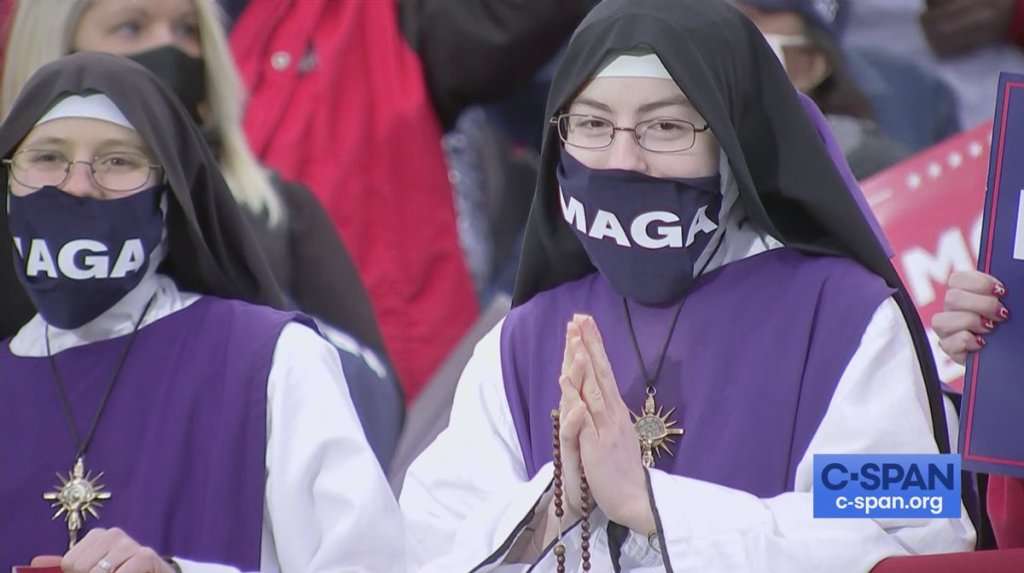
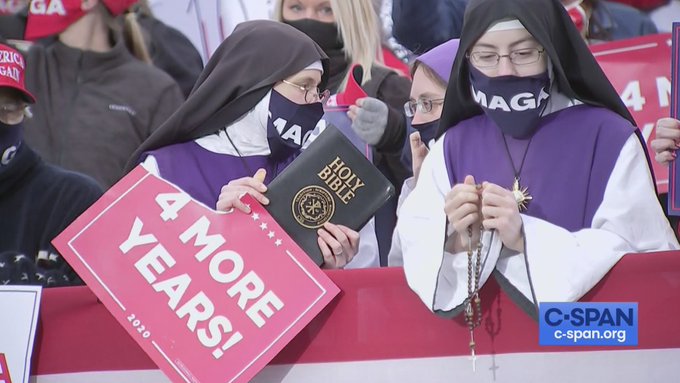
On Mortman’s feed, a long discussion ensued about whether or not these women were actually nuns, or if they were cos-players, or if they had been hired by the T___p campaign, and so on.
A shorter and similar discussion was also going on Hend Amry’s feed, which I joined.
People were questioning why they were wearing wedding bands and a fancy crucifix, why they are at a political rally, why would anyone committed to Jesus/Christianity/Catholicism support T__p? (why he has the Evangelical vote despite the utter hypocrisy of this baffles many) what was up with the purple habit, etc?
My interest was struck by the main question: “Are these real nuns?”
I googled “nuns in purple habits” (as did @Flother2, a person with whom I had a great conversation, who had the wonderful phrase “I’m not a Catholic but I can google”) and arrived at the Children of Mary. (https://www.childrenofmary.net).
Immediately, I was struck by the similarities between their founding story and that of Sister Domenica da Paradiso, the 16th century mystic who lived in Renaissance Florence, who I’ve been studying and writing about for years. However, as I noted in my Twitter response, Sister Domenica was against a despotic ruler (the Medici family) not for one.
The hagiographic story on the Children of Mary history section mirrors that of Sister Domenica da Paradiso’s biography. According to their website, they can’t determine an exact date for their foundation, but they can land on 1989 as the “Mother Foundress” was told by Jesus to “go, sell all you have and follow me” (link to the website above, the History section). She moved to Newark, Ohio and lived as a hermit for eleven years in silence. With prayer and “hard manual labor” filling her days, she had meetings with a spiritual director and then began to meet the bishop to see if “Mother had an authentic calling.”
It was all deemed acceptable, and the Bishop asked her to have other women come and join her at the hermitage. After another year passed, the Mother had a vision in which Jesus approved the foundation of her community on the feast of St Margaret Mary Alacoque (October 16). As the website notes, “She spent the rest of the year trying to put this experience into words and images and presented it to Bishop Griffin, who then gave her the name Mother Margaret Mary.” https://www.childrenofmary.net/history/
The website then notes that “Mother had an audience with his Holiness, St John Paul II and presented him with the booklet of our charism. Later, he communicated to her through the Chancery Office that he was praying for her and her intentions.” (charism is defined as “an extraordinary power (as of healing ) given a Christian by the Holy Spirit for the good of the church” https://www.merriam-webster.com/dictionary/charism
In 2002, “Mother was consecrated by Bishop Griffin in our Chapel in Newark, Ohio.” (all quotes from the website)
And while the “decree of erection for a canonical house of the public association of the faithful “Children of Mary” is proudly displayed on the website, there is no papal bull.
Which means the order is not Vatican approved.
Which means they are not “real” nuns.
Which brings us back to Sister Domenica da Paradiso.
Like the “Mother” foundress of Children of Mary, (or really, the other way round) Sister Domenica began her order after living alone – in a room in her family’s house, then in private citizen’s house in Florence, then in her own house with a group of her followers. This is textbook hagiography for female anchorites who go on to found orders.
Sister Domenica also had a spiritual director (Francesco da Castiglione) who assisted her in her endeavours, and recorded her life and visions in a series of unpublished manuscripts. She had the support of the vicar of the archbishop, and eventually was able to build the convent of La Crocetta in 1511, with archiepiscopal approval. She was affiliated with the Dominicans, but unusually, her order was under the direct supervision of the archbishop of Florence. This was because she had many disagreements with the friars of San Marco, who had once followed Fra Girolamo Savonarola, and were trying to make sure that Sister Domenica followed their orders. Unusually independent and politically savvy, Sister Domenica insisted that her mandate to found a convent came from Jesus himself (sounds familiar? ) and she was vested in a vision by St Dominic.
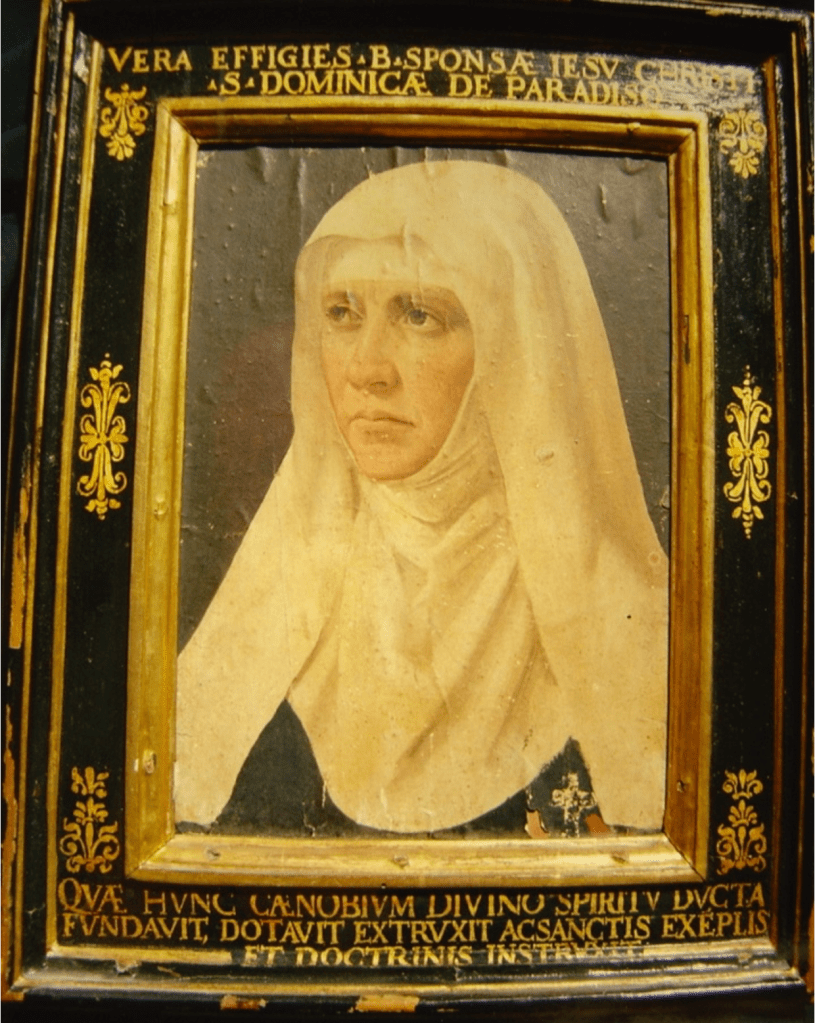
Sister Domenica received papal approval for her new order in a Bull from Pope Leo X in 1515, making the convent of La Crocetta official. However, Sister Domenica remained a tertiary (member of the Third Order of Dominicans) until the year before she died, which meant that unlike the women who became nuns and lived in her convent, she was not cloistered and could leave the convent. She only took final vows and became a “real” nun the year before she died.
With visions of political doom and gloom for the Medici family, and claims of advice given to the Republican rulers of Florence during the Medici exile, Sister Domenica was every bit as political as these Children of Mary. However, she privately referred to the Medici family, who enjoyed the trappings of power and wealth as tyrants.
I don’t have time to get all my thoughts down, but nuns have historically been political. Sadly, I feel these Children of Mary are on the wrong side of history.
 Meghan Callahan